
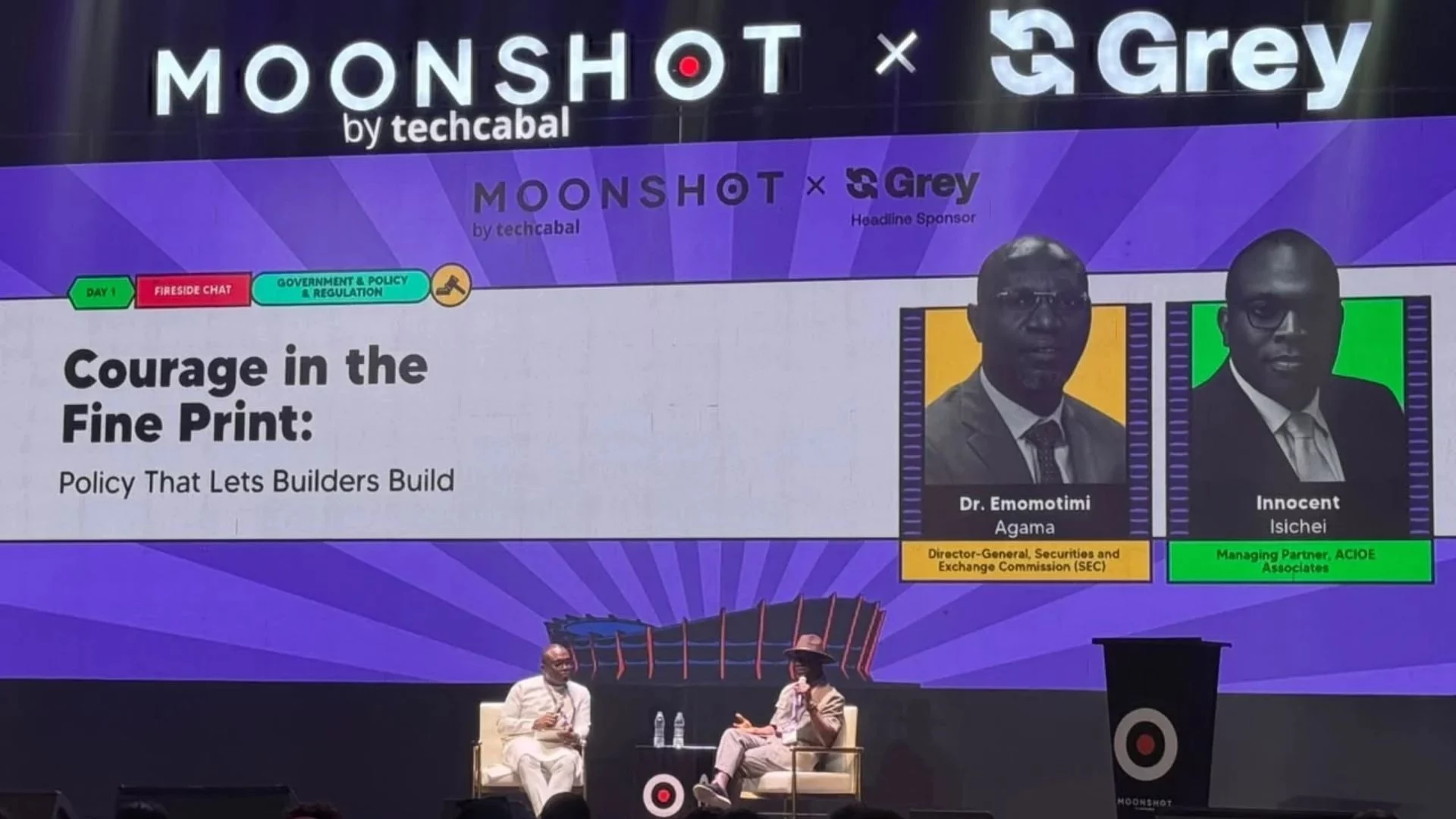
Nigeria's Securities and Exchange Commission director-general Emomotimi Agama stepped onto the Moonshot by TechCabal stage in Lagos on Wednesday with a direct message for founders: stop looking overseas first. Agama laid out a practical path to the stock market that starts closer to home, beginning with crowdfunding from people who already trust you, then moving through instruments like commercial paper to test broader investor appetite. He also made a case for debt as a way to fund growth without giving up equity, though he drew a firm line at one common mistake. "That's a mismatch that will drown you," he said of founders using short-term bank loans to chase long-term goals.
The SEC's push for local listings sits inside a much bigger ambition. On October 19, Vice President Kashim Shettima unveiled the Nigerian Capital Market Master Plan 2.0, a 10-year roadmap targeting 750 trillion naira, roughly 549 billion dollars, in market capitalisation by 2036. Agama noted the market has already moved sharply, growing from 55 trillion naira in 2024 to more than 162 trillion naira today. He pointed to the Dangote Petroleum Refinery IPO, which closed on October 27 after an SEC-approved extension, as proof of appetite: investors from all 54 African countries subscribed.
For crypto founders, the message carried a sharper edge. In January, the SEC raised the minimum capital requirement for digital asset exchanges and custodians from 500 million naira to 2 billion naira, with a compliance deadline of June 30, 2027. Agama urged young founders who cannot meet that bar on their own to find partners and pool resources. His analogy was blunt: "You cannot be a cockroach and decide to wrestle with elephants."
Licensing remains a sore point in the room. An audience member from the Virtual Asset Service Providers Association pressed Agama on why no crypto platform holds a full licence, more than two years after the SEC launched its Accelerated Regulatory Incubation Programme in June 2024. Quidax and Busha received provisional licences in August of that year and are still waiting. Agama said the SEC has charged ARIP firms no fees while it assesses the risks in their businesses, and acknowledged that other regulators share the space, which slows decisions.
His closing line on unregulated investing was the one that lingered in the room: "If you are not an investor, then you must be a victim." For founders still deciding where to raise their next round, that framing is hard to ignore.
Originally published by TechCabal.