
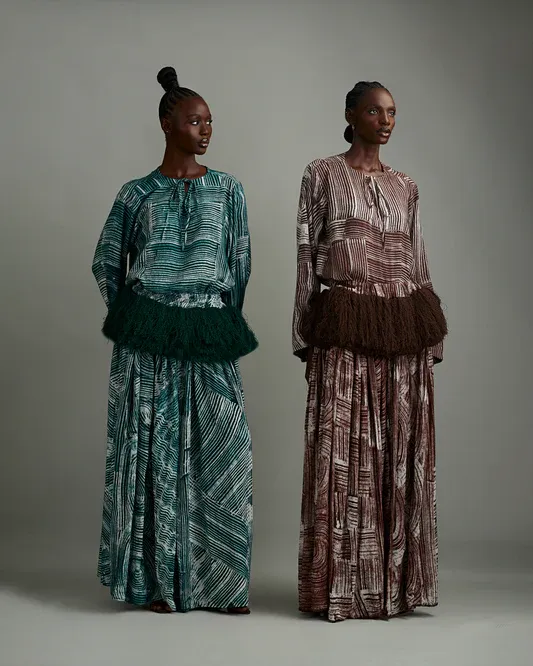
Hertunba’s Akaorụ (Igbo for “handwork”) treats craftsmanship as the main story, not an afterthought, positioning the collection as a quiet but confident manifesto for Nigerian handwork. The drop leans into the beauty of clothes made slowly and intentionally, where every stitch, cut and finish is the result of deliberate human effort rather than speed or trend cycles, and where “handwork” is framed as something worthy of reverence rather than something to be hidden behind logos or trends.
Every piece is handcrafted in Lagos by a community of artisans, weavers and tailors trained by the brand, grounding the clothes in real people and real labour instead of anonymous factory lines. The collection is described as “made by real artisans, real craft, real stories,” underscoring how Akaorụ is built around lived skills and a deeply rooted craft tradition rather than surface‑level design alone, with each garment treated as a collaboration between designer and maker rather than a one‑way creative directive, a dynamic you can see in the way the brand talks about its production on the official collection page here.
Across editorials and brand captions, Akaorụ is framed as a modern expression of an ancient, interconnected craft culture, with silhouettes, textures and finishing all used to highlight process over spectacle. Clean lines, controlled proportions and tactile fabrics are favoured over heavy embellishment, allowing construction and material to carry most of the visual interest, while the imagery focuses on close‑ups of seams, pleats and woven surfaces that make it clear the point is to notice how the clothes are made, not just how they look in motion.
@elianasefah Designer: Hertunba Collection: Akaorụ (Igbo for Handwork) Every piece is handcrafted in Lagos by a community of artisans, weavers, and tailors trained by the brand. #luxuryfashion #editorial #africandesigner #africanfashion
♬ original sound - Paris & Lake Como Photographer
Akaorụ ultimately positions Hertunba in a space that values process, precision and clarity, offering a considered alternative to more trend‑driven outputs in Nigerian fashion and suggesting a template for what a slower, more intentional future could look like for ready‑to‑wear on the continent. A detailed write‑up on the collection’s craft‑first approach breaks down how it centres materials, construction and execution at every stage, situating it within a wider conversation about African designers reclaiming and redefining “handwork,” and is worth a read here.