
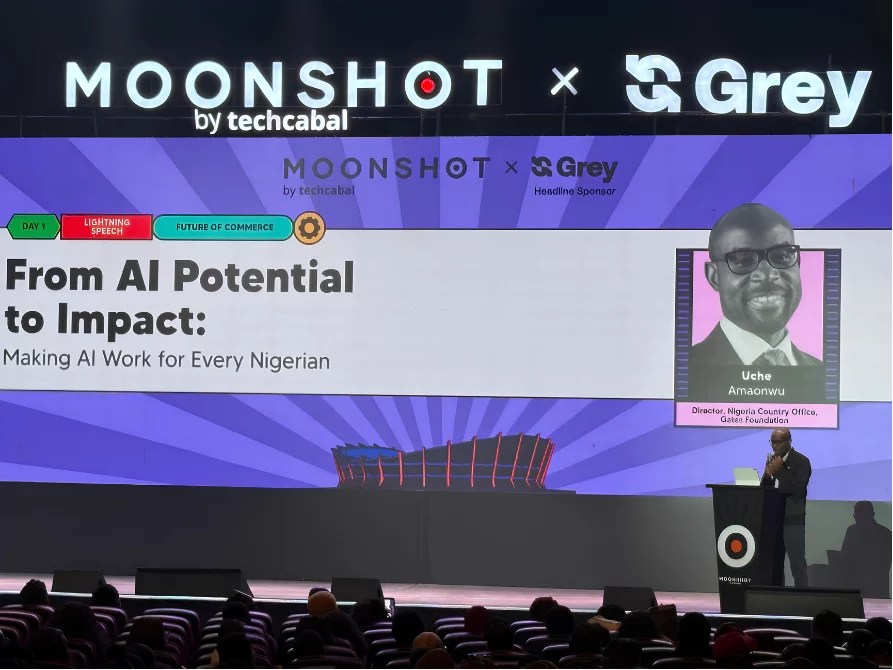
At the Moonshot conference in Lagos last Wednesday, Uche Amaonwu, Director of the Gates Foundation Nigeria Country Office, made a pointed case: Nigeria's AI progress should not be measured by how many products get launched. It should be measured by how many lives actually change.
Amaonwu pointed to healthcare, education, agriculture, and public services as the sectors where AI investment needs to land. He was direct about what the real test looks like. "The real test is whether people are going to be able to use these AI solutions and tools, whether there is an institution that can sustain those tools over time, and whether we actually see better outcomes from the use of those tools." That framing sits at the heart of the Gates Foundation's thinking, which holds that AI could be a great equalizer, expanding access to knowledge and services for people historically left out of tech's benefits. The Foundation's 2026 Goalkeepers report carries a sharper warning too: without deliberate action, that same technology could widen existing inequalities instead.
McKinsey estimates that generative AI could unlock between $61 billion and $103 billion in economic value across African sectors. But Amaonwu argues that getting to that number requires Nigeria to build the right foundations first. He pointed to fintech as the model. Nigeria's payments boom worked because infrastructure, regulation, policy, and capable institutions came together. AI, he said, needs the same conditions: reliable connectivity, trusted data, and systems that can communicate with each other.
Two more conditions keep coming up in his analysis. First, the AI tools Nigerians use need to be built around Nigerian realities. Most advanced AI models are developed outside Africa and trained on data that may not reflect the continent's languages or lived experiences, which limits how useful those tools can actually be on the ground. Second, trust has to be built in from the start, especially in sensitive sectors like healthcare where AI will be handling private data and accountability cannot be an afterthought.
The message from the Gates Foundation is not that Nigeria should slow down. It is that speed without the right architecture produces products, not progress. The question now is whether the institutions, the regulators, and the builders are ready to close that gap together.
Originally published by TechCabal.