
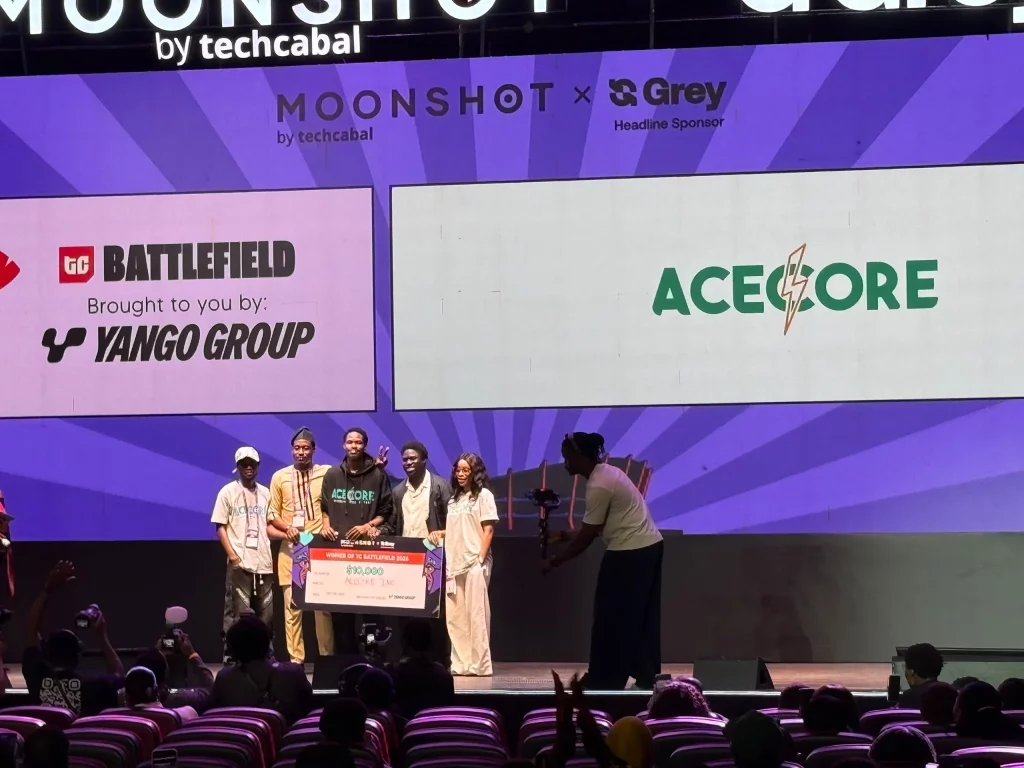
Caleb Iwuoha was assembling battery systems in a shed in Oyigbo, Rivers State, when most people would have told him Nigeria was the wrong place to build hardware. On October 29, he walked away from TC Battlefield at Moonshot in Lagos with a $10,000 first prize for Acecore, the battery company he has been growing since 2024. Two of the three winning startups from the annual competition are building physical products in a country that imports the vast majority of its technology, and that detail alone made the evening worth watching.
Acecore's flagship product is the PowerCell, a wall-mounted cabinet that combines a battery, an inverter and a charge controller into a single unit. It stores electricity from the grid or solar panels and keeps homes and businesses running when power cuts out, replacing the patchwork of separately wired components or diesel generators most Nigerians rely on. An app called PowerCore tracks consumption and flags when maintenance is needed. A 5kVA, 10kWh unit starts at $5,250, with financing available through Sterling Bank, SunFi and Earthbond. Iwuoha told the judges the casing and battery software were built in Nigeria, by hand, and monthly output has grown from 8kWh to more than 320kWh since the company started. Acecore holds MANCAP certification and reports $164,000 in purchase orders from buyers including Chopbox, PartyRice and Skydiamond Homes.
The company says it undercuts rivals including Lumos and Greenage Technologies by 10% to 20%, citing a price of $5,250 against a competitor's $6,200 for a comparable unit. One judge pointed out that imported Chinese systems arrive in Nigeria at a similar price point, which is a real tension for a company pitching local manufacturing as its advantage. Nigeria imported 1,721MW of Chinese solar panels in the year to June 2025, the second-highest volume in Africa according to Ember, and Acecore has not disclosed where its battery cells are sourced. The stronger pitch, honestly, is the manufacturing itself: a workshop producing backup power systems in Rivers State is a different kind of story from a Lagos distributor reboxing imports.
Supplya, which lends to small retailers, took second place and $5,000. Navidyn, a developer of underwater robots, came third and received $2,500. Both companies also earned spots in Antler's residency programme, putting them in line for up to $250,000 in pre-seed funding. Three very different bets on what Nigeria can build, lend and explore, and the judges picked all three deliberately. It will be worth checking back on all of them in twelve months.
Originally published by TechCabal.