
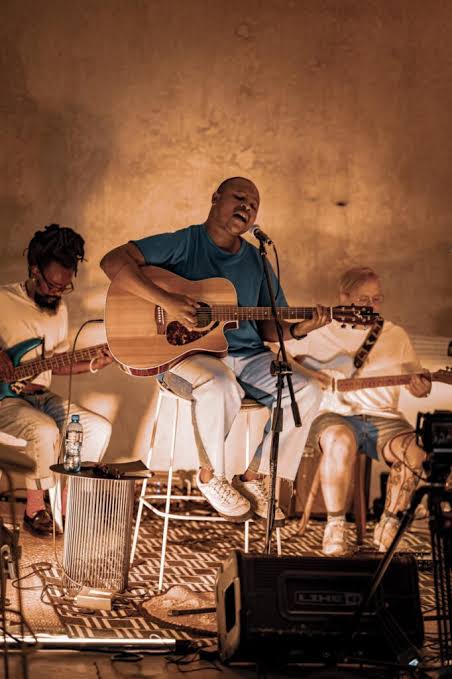
Muneyi’s new album “Shumela Venda” lands as a major statement from one of South Africa’s most singular voices, released at the end of May 2026 as his latest full‑length project. Rooted in Tshivenda indie‑folk but stretching into jazz, choral textures and ambient sound design, the record extends the intimate, searching work he began on “Makhulu” and his later EPs into a larger, more explicitly historical canvas. It is arriving in a moment where he is already under a bright spotlight as the 2025 Standard Bank Young Artist for Music, turning that platform into a space for language, memory and land to speak back to power.
At its core, “Shumela Venda” is an album about contested history. Drawing on archives, news reports and family memory, Muneyi revisits the story of the Venda Bantustan—its declaration of “independence” under apartheid, the violence that followed, and the community resistance that helped bring that experiment down. Songs move between turbulent endings and auspicious beginnings, creating a sonic world where TshiVenda stories that were pushed to the margins can sit at the center. One track incorporates audio from 1988 protests over medicine murders and the regime of Patrick Mphephu, forcing listeners to hear how state violence and spiritual harm were woven together in that period. You can read a deep dive into how the album revisits Venda’s unfinished story here.
Musically, the project keeps his signature intimacy intact even as it deals with heavy themes. His guitar and voice sit upfront, surrounded by arrangements that can feel as sparse as a folk confession or swell into ensemble‑like passages that nod to marabi, jazz bands and church choirs. The warmth people heard in “There’s a Burning Sensation Where My Heart Used To Be” is still present, but now it’s carrying stories of land claims, spiritual unease and community survival rather than just personal heartbreak.
“Shumela Venda” is also being treated as a live ritual, not just a studio artifact. On June 20, 2026, Muneyi returns to the University of Johannesburg—ten years after he first left—as he stages a one‑man “Shumela Venda” concert at the Keorapetse William Kgositsile Theatre, presented with UJ Arts & Culture and Standard Bank. The performance is framed as an intimate homecoming where songs from the album are woven together with storytelling and reflection, turning the launch into a ceremonial act of writing Venda back into South Africa’s broader narrative. You can find more on the “Shumela Venda” concert experience here.
For Muneyi, this album builds directly on years of work where he has used music to hold space for grief, love, queerness and self‑forgiveness. With “Shumela Venda,” those intimate concerns are inseparable from political history, making the record feel like both a love letter and an inquiry into what was done to his homeland and what it means to heal. In a year crowded with big Afropop releases, he is quietly offering something different: a folk album that functions like a living archive, asking listeners to see Venda not as a footnote, but as a central chapter in South Africa’s story.