
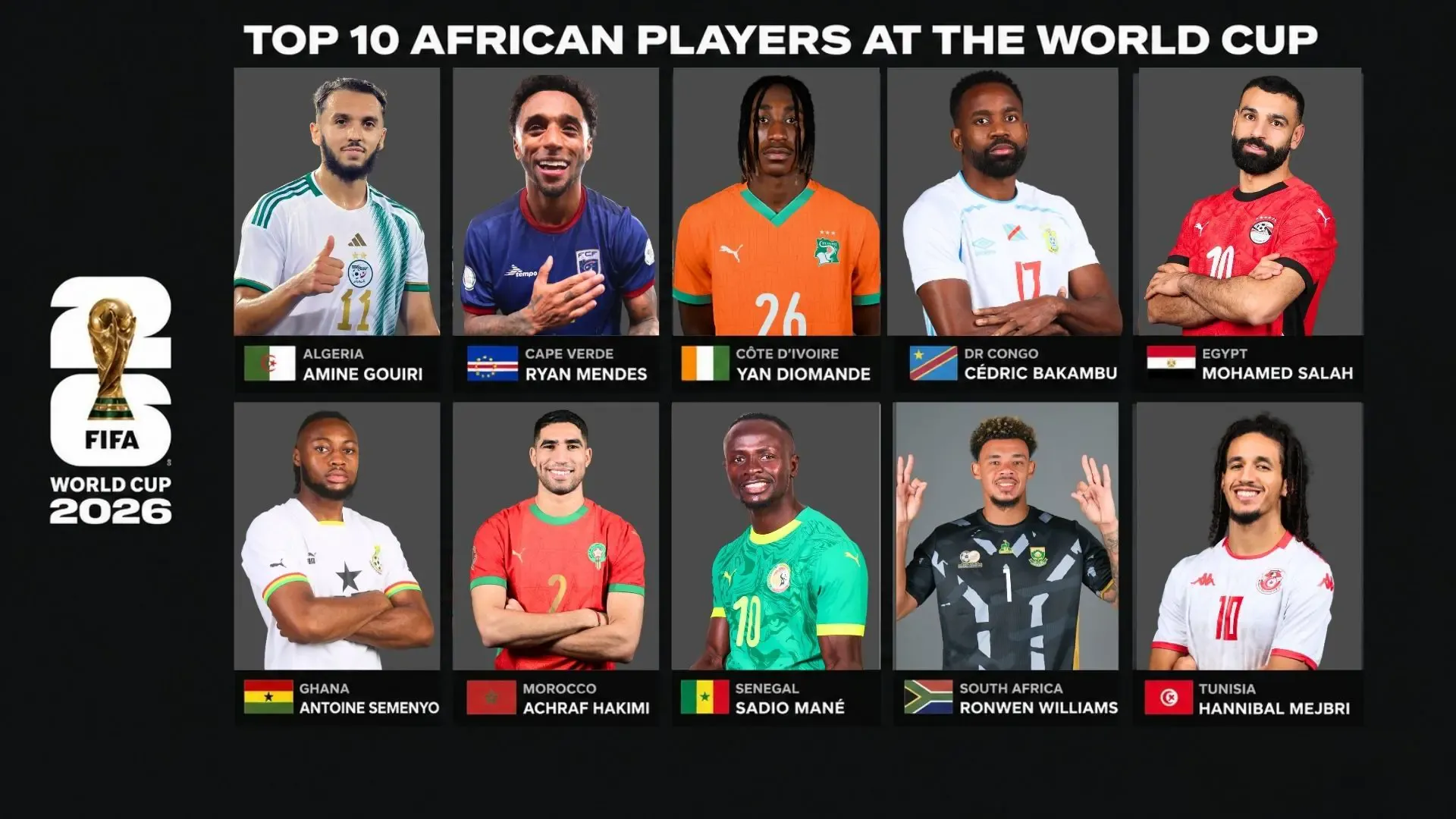
The 2026 World Cup is quietly a tournament of migration stories, with a quarter of all players representing countries they weren’t born in—and African talent is right at the center of that shift. A recent breakdown counts 310 footballers at this year’s tournament who were born outside the nations they play for, reflecting how global movement over the last 50 years has reshaped national teams.
Some of the most striking numbers are tied directly to Africa and its diaspora. France alone has 75 players born in the country who will actually be turning out for other nations in North and West Africa and beyond, a sign of how French academies and banlieue neighborhoods continue to produce talent that later “returns” via dual‑nationality choices. Meanwhile, African‑origin players are also turning up in European and Middle Eastern squads: England’s Marc Guéhi was born in Côte d’Ivoire, France have three foreign‑born players of African descent in Michael Olise (England), Marcus Thuram (Italy) and Brice Samba (DR Congo), and Qatar’s 14 foreign‑born players include men from Ghana, Senegal and Somalia. A full country‑by‑country breakdown of foreign‑born World Cup players is summarized here.
On the African side, some teams have leaned heavily into diaspora recruitment. DR Congo arrive with 20 players born outside the country—11 in France, five in Belgium, two in England and two in Switzerland—while Morocco bring 19 foreign‑born players with a strong Spanish and French influence through stars like Achraf Hakimi and Brahim Díaz. Algeria’s 16 foreign‑born squad members are mostly France‑born, and Senegal, Tunisia, Cape Verde and Côte d’Ivoire all field double‑digit or high single‑digit numbers of players born in Europe. This model reflects decades of FIFA eligibility tweaks that allow dual nationals to switch allegiance if they haven’t been cap‑tied competitively, creating pathways for players developed in European systems to represent their ancestral homes.
But not every African team is built this way. South Africa’s Bafana Bafana, for example, have taken almost the opposite approach, arriving at the tournament with a squad made up entirely of home‑born players. Analysts see that as a deliberate statement about investing in local leagues and development—even as other nations demonstrate how powerful the diaspora pipeline can be in raising the ceiling of national‑team quality.
Together, these patterns show how deeply African talent is woven into the global game: fueling European and Middle‑Eastern teams, boosting African sides through diaspora stars, and raising new questions about identity, belonging and what “national team” really means at a World Cup where birthplace, passport and personal history rarely line up in a straight line. For fans who want to follow the numbers, the detailed Flashscore report on foreign‑born players at 2026 is a useful reference here.