
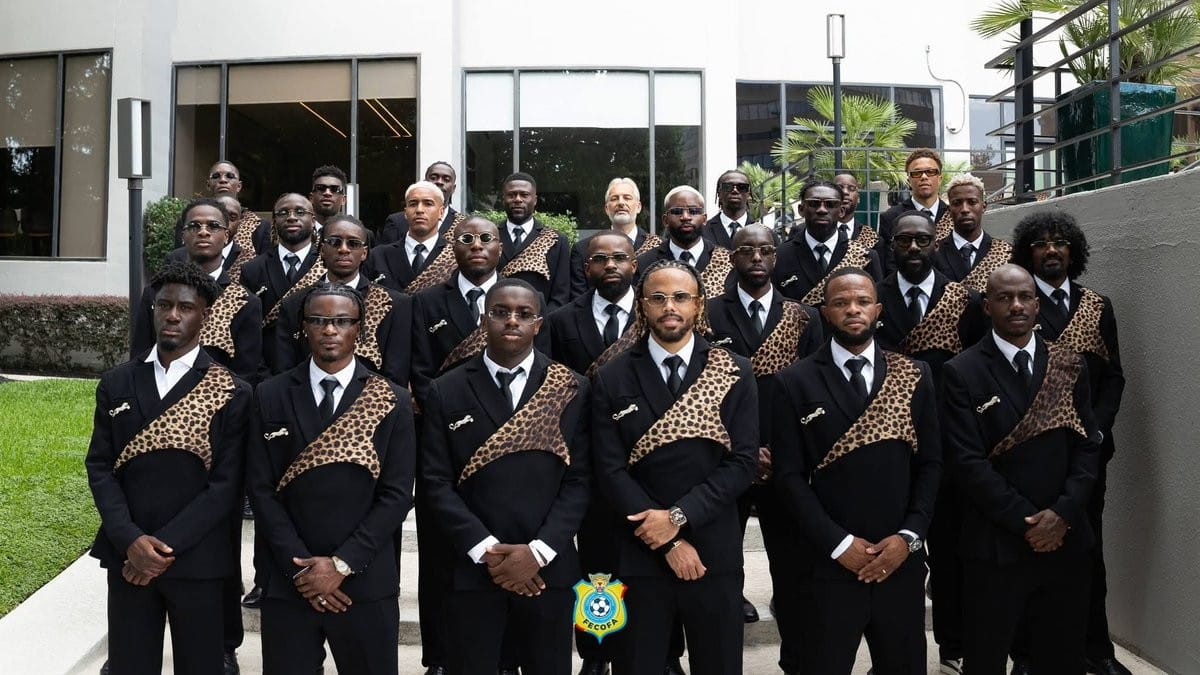
DR Congo have already won something at this World Cup: the fashion conversation. The Leopards’ arrival in the United States went viral after the squad landed in Houston dressed in coordinated suits with bold leopard‑print accents, a visual statement that announced both their return to the tournament and their pride in Congolese identity. Social clips show players stepping off the plane in tailored looks trimmed with leopard motifs, with captions joking that “DR Congo won the World Cup… at least the fashion part” as fans around the world praised the team’s style; one of the most‑shared reels is collected here.
The choice of leopard imagery is far from random. The leopard has long been a national symbol in the Democratic Republic of Congo—associated with power, vigilance and leadership—and the national team’s nickname, Les Léopards, comes directly from that heritage. By putting leopard print on their travel fits and kits, the team is leaning into that identity in a way that feels modern and self‑aware: it’s culture, branding and morale boost all at once, especially meaningful as this is their first World Cup appearance since 1974, when they played as Zaire.
@brutamerica The DR Congo men’s national soccer team arrived in Houston on Thursday, June 11, ahead of its first World Cup appearance in more than 50 years. Known as “the Leopards,” the players landed in coordinated black suits featuring leopard-print details and carried matching leopard-print travel bags before heading to their hotel. DR Congo will open its group-stage campaign against Portugal on Wednesday, June 17, in Houston. The team is also set to face Colombia and Uzbekistan in Group K. The team’s World Cup preparations were relocated to Belgium in May after an Ebola outbreak in the Democratic Republic of Congo forced the cancellation of a training camp and fan sendoff in Kinshasa. #worldcup2026🏆 #worldcup #fifa #drcongo #drcongo🇨🇩❤️ Video: Courtesy of FIFA
♬ original sound - Brut. - Brut.
Umbro’s 2026 kit collection picks up the same story in more subtle ways. The home jersey is a vibrant, light‑blue strip long associated with DR Congo, but the lower half features a custom, tone‑on‑tone leopard‑print texture and wavy graphic pattern that rises from the hem, fading into the fabric. Red and white trim on the collar and cuffs mirrors the national flag, while the FECOFA crest sits over the heart with two stars marking their historic 1968 and 1974 AFCON titles, backed by matching light‑blue shorts and socks.
The away kit keeps the motif going in a cleaner way: presented in bright white, it carries a subtle tone‑on‑tone leopard print across the fabric and a geometric diamond pattern that transitions from white at the top into blue tones at the bottom. Retailers describe it as balancing “visual simplicity with strong symbolism,” using the big‑cat pattern as a quiet nod to strength and unity rather than full‑blast animal print. A detailed breakdown of the full home/away/third set, with close‑ups of the leopard detailing, is available here.
What makes DR Congo stand out is how joined‑up the aesthetic feels: from the airport suits to the match strips, everything is built around the same leopard story. Fashion pieces have noted that the 2026 design “symbolizes the power and heritage of Congolese football,” and fans are already snapping up replicas that let them wear that identity whether they’re in Kinshasa, Paris, London or the U.S. host cities. In a tournament full of template kits and safe airport looks, the Leopards have leaned into something specific and rooted—and that, more than anything, is why they’ve become early fan favourites in the style stakes.